
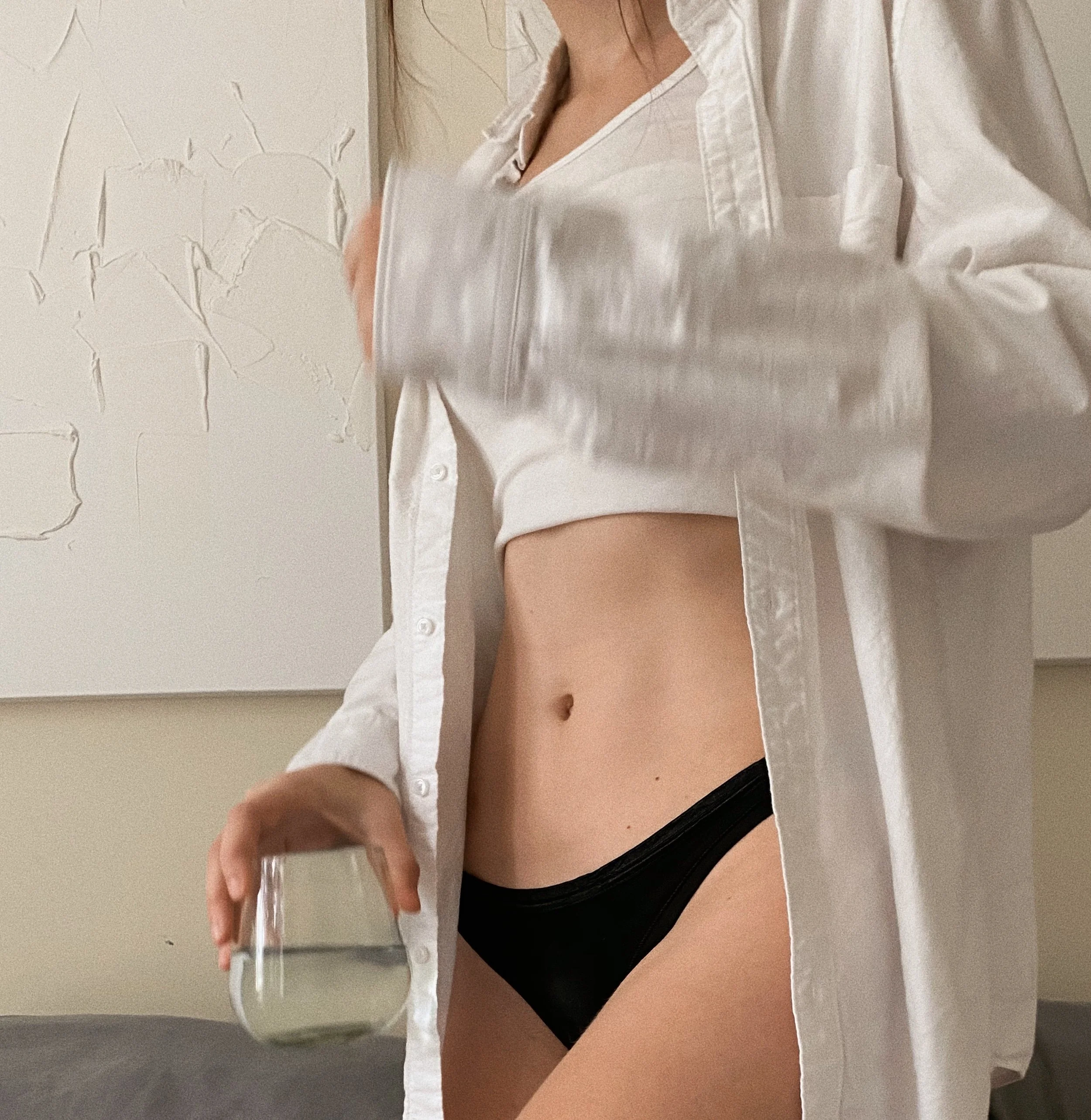
Looking to upgrade your underwear drawer with comfy, breathable pieces? Without all the confusion about certifications, fabrics, fits, and brands? I got you.
This post shares 6 of my favorite tried-and-true underwear brands and who each brand is best suited for!
If you’ve started paying more attention to what your clothes are made of, underwear is a pretty logical place to start.
It sits directly against some of the most sensitive skin on your body for hours every day. And yet, so many conventional options are made primarily from synthetic fabrics like polyester and nylon.
Do I think this means you need to go dump your entire underwear drawer in the trash? Absolutely not.
When I’m buying new underwear anyway, the first thing I look at is the fabric. I personally prefer natural fibers, certified organic cotton, and breathable cellulose-based materials like lyocell over underwear made primarily from synthetic materials.
I also look for third-party certifications, supply-chain and production transparency, and brands taking meaningful steps toward more sustainable practices.
But, and this is important, I also want my underwear to actually be comfortable. I don’t care how impressive the certifications are if the pair digs into my hips, feels bunchy, or rides up all day (IYKYK)…
Thankfully, there are now quite a few organic underwear brands and sustainable underwear brands making genuinely cute, comfortable options.
I compared six of the best to help you figure out which one is actually right for you.
The Best Non-Toxic and Organic Underwear Brands at a Glance
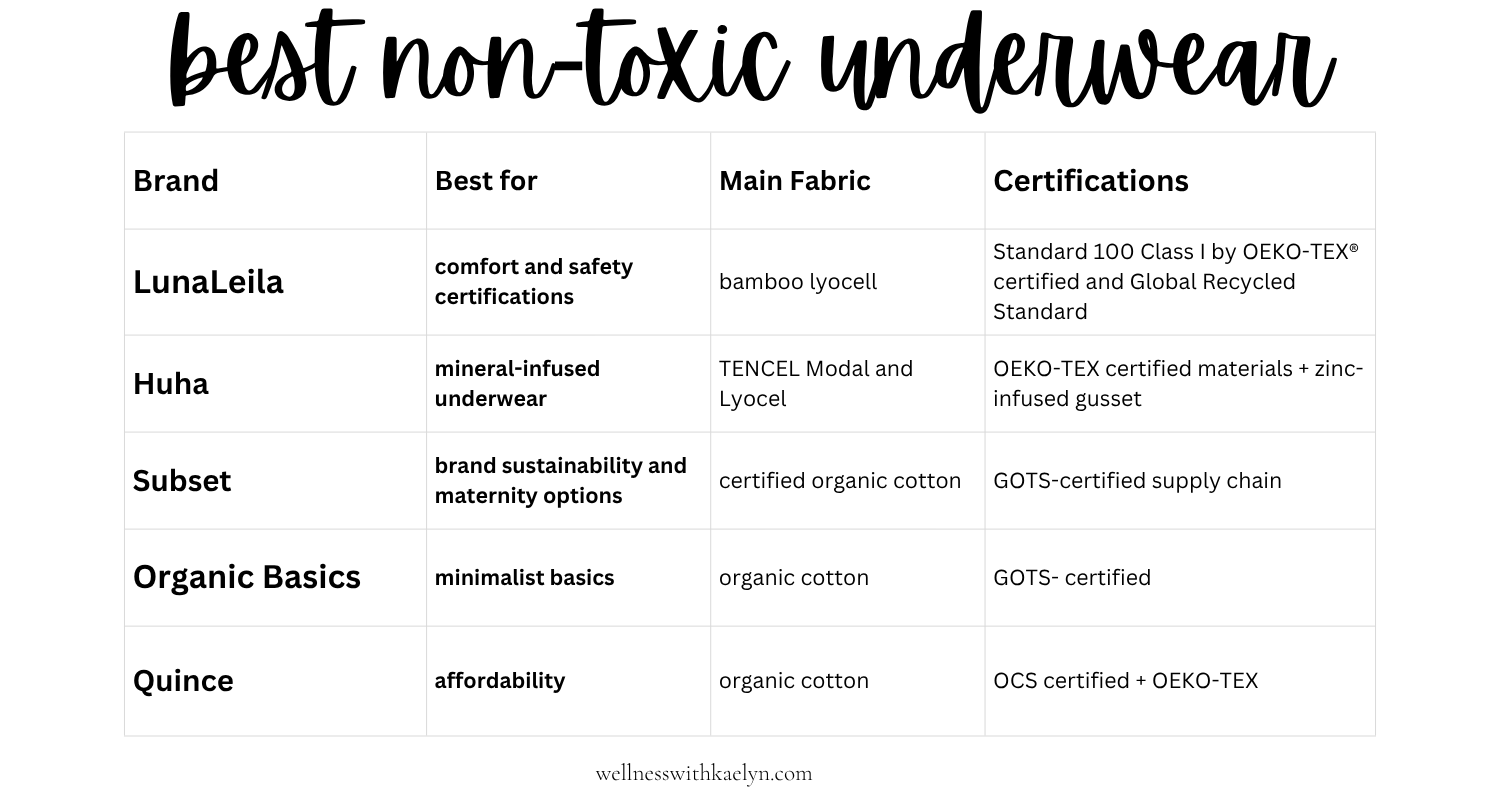
My quick recommendation:
If you are looking for an extremely soft, buttery and barely-there feel, choose LunaLeila (also, they’re Standard 100 Class I by OEKO-TEX® certified 👏)
If you are specifically looking for organic cotton, Subset or Organic Basics are both great choices.
If you are looking for the most budget-friendly option, check out Quince.
And if you’re interested in mineral-infused underwear made of OEKO-Tex Tencel, check out Huha.
I think underwear is so personal and situation-dependent that there really isn’t a one-size-fits-all option. But I’ve tried to break down my brand recommendations into what really sets each brand apart.
What Does “Non-Toxic Underwear” Actually Mean?
Before we go any further, I want to clarify what I mean when I use the term “non-toxic.”
It isn't a regulated category.
You'll see terms like clean, natural, organic, PFAS-free, and non-toxic used throughout the fashion industry, but they don't all mean the same thing.
So rather than taking “non-toxic” at face value, I look at what the underwear is actually made from and what information the brand gives us to back up its claims.
Natural and organic fabrics
I generally prefer natural fabrics like organic cotton and breathable cellulose-based fabrics like lyocell over underwear made predominantly from polyester or nylon.
Organic cotton is especially appealing because certified organic cotton is grown according to standards that restrict certain synthetic pesticides and fertilizers. Organic farming practices such as crop rotation can also play a role in soil health.
That doesn't mean organic cotton is magically perfect for the planet. The environmental impact of any fabric is complicated. But if I'm buying new underwear anyway, I personally like to look for certified organic cotton or an OEKO-TEX certified semi-synthetic.
Third-party certifications
Certifications can tell you far more than vague claims about a product being “clean.”
One of the certifications you'll see frequently in this guide is the Global Organic Textile Standard, or GOTS. GOTS goes beyond simply verifying the organic cotton fiber itself and includes requirements surrounding textile processing and the supply chain.
OEKO-TEX Standard 100 is another certification I like seeing because it tests finished textiles according to limits for a long list of potentially harmful chemicals.
Neither certification means a product is completely “chemical-free", but I appreciate having more information about the finished textile.
PFAS and chemical transparency
I also appreciate when brands provide clear information about substances consumers may be specifically trying to avoid.
Some brands on this list disclose information about PFAS, formaldehyde, dyes, or other toxic chemicals and harsh chemicals.
I'm not interested in fearmongering about clothing, but I am a big fan of brands simply telling consumers what they're doing. More transparency makes it easier for us to decide what matters to us.
Comfort and breathability
Maybe this should actually be number one. Because the highest quality underwear still isn't worth buying if you hate wearing it. Breathability, softness, coverage, seams, rise, and body type can all influence which pair works best for you.
You'll also notice that most of my recommendations contain a small amount of elastane or spandex. I'm okay with that. Actually, I personally prefer it in underwear and bras.
I don't think underwear needs to be made exclusively from natural fibers to be a worthwhile swap. A small amount of stretch can dramatically improve ultimate comfort, fit, and longevity.
LunaLeila — Best for Comfort and Safety Certifications
Do you want underwear that is lightweight, breathable, and gives you that no-underwear feel? LunaLeila may be the perfect choice.
LunaLeila makes its underwear from its Luna-Boo™ fabric, which is 95% bamboo-derived lyocell and 5% spandex. The result is incredibly lightweight, soft, underwear with four-way stretch that feels more like a second skin than a pair of traditional cotton underwear.
But the material isn't the only reason LunaLeila made this list.
LunaLeila's fabric is OEKO-TEX Standard 100 Class I certified, the most stringent OEKO-TEX product class and one designed for products with particularly sensitive skin contact (like babies)!
I appreciate their level of transparency, product comfort, and the color options are simply stunning.
What I love
95% bamboo-derived lyocell
Extremely lightweight and soft, breathable and moisture-managing
OEKO-TEX Standard 100 Class I certified
Feminine cuts and colors
Barely-there feel
Doesn't have the bulky feeling some organic cotton undies can have
Things to consider
LunaLeila is more of an investment upfront. Currently, each pair are $29 while you have the option to buy 3 pairs in a bundle for around $74.
Lyocell also feels a bit different from cotton. It's a thinner, silky fabric that gives you that "not wearing underwear" feel. These are my absolute fave for lounging and sleeping! But if you are a traditional cotton underwear person through and through, check out some of the other recommendations.
They have a more limited line of cuts and styles compared to other brands on the list. That said, the two underwear styles they currently offer are both comfortable to wear and cute on!
My verdict
LunaLeila earns its spot in this guide because it offers something genuinely different from the cotton options. They stand apart with some of the strictest certification standards and are the lightest-feeling of any I’ve tried.
For someone who wants lightweight, breathable underwear without relying primarily on synthetic fabrics, this is the standout.
You can read my full LunaLeila review here.
Disclosure: LunaLeila sponsored its inclusion in this guide. As always, sponsorship does not guarantee a positive recommendation, and all opinions are my own.
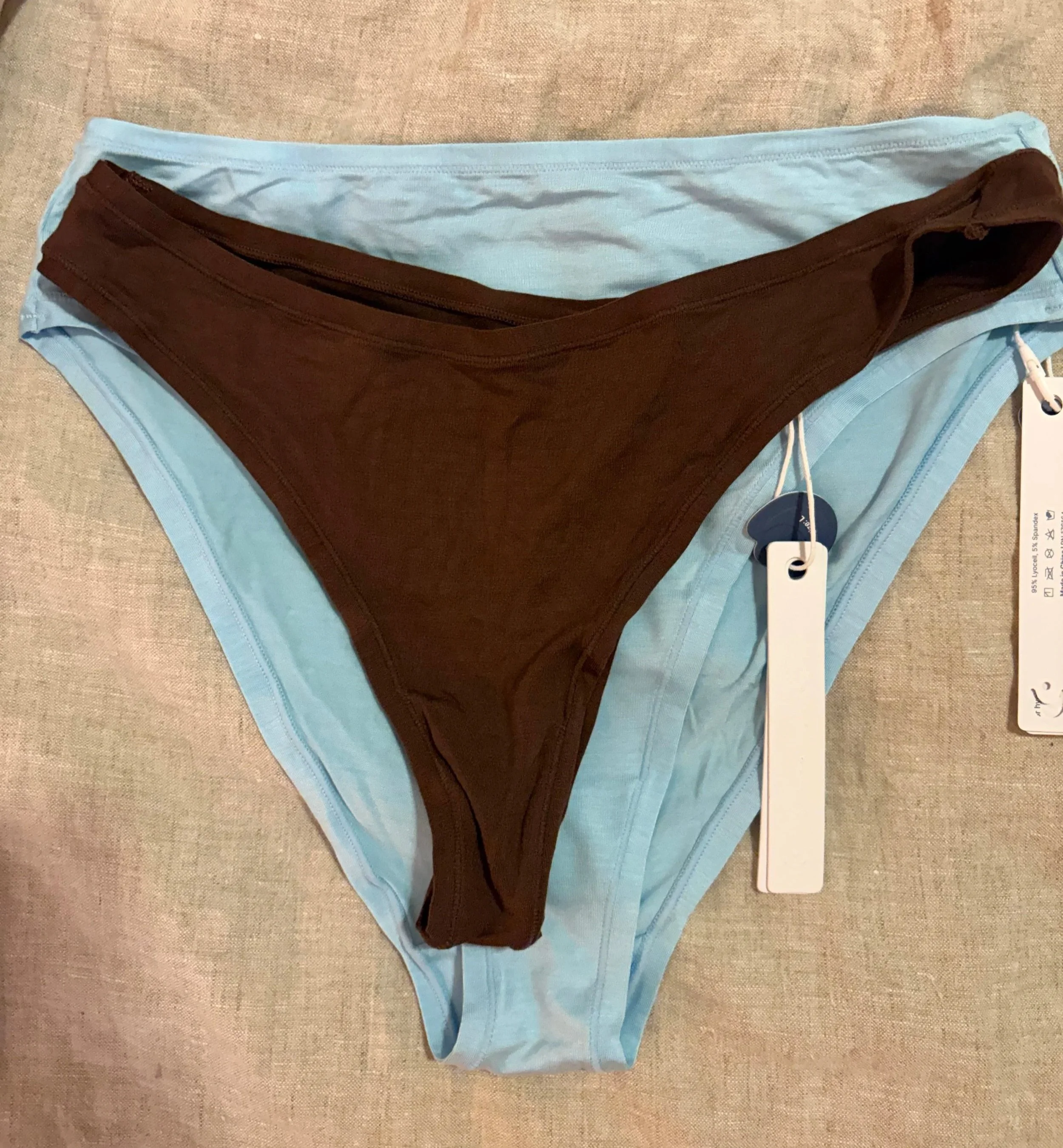
LunaLeila balance thong and elevate high-rise bikini
Huha — Best Non-Toxic Mineral-Infused Underwear
Huha has become one of my favorite underwear brands because it approaches underwear a little differently. Rather than using conventional cotton or synthetic performance fabrics, Huha primarily uses tree-derived TENCEL™ fibers.
Its Mineral Undies also feature an extended gusset knit with zinc oxide, which the brand incorporates for its antimicrobial and odor-reducing properties.
Huha says its materials are OEKO-TEX certified, and its underwear is designed specifically around breathability and moisture management. The fabric has a very different feel from traditional cotton underwear. It's incredibly soft and smooth, but what really separates Huha from many of the other brands on this list is the gusset.
Have you ever tried underwear that comes with the tiniest strip of fabric in the one place you’d really prefer a little more coverage… same 😅 I appreciate that Huha’s lining offers you a bit more coverage without bunching up.
What I like
soft TENCEL™ fabric
Excellent breathable underwear for everyday wear
Generous gusset
Zinc oxide incorporated into the lining
OEKO-TEX certified materials
Lots of different styles and an inclusive size range
Things to consider
Price is honestly probably the biggest downside. If you’re replacing ten pairs of underwear at once, Huha adds up quickly. That said, you can get a discount when you buy multiple pairs in one order.
Also, some of their prints are only available for a limited time. I’ve occasionally seen a print I really loved, only for it to sell out by the time I go to purchase.
My verdict
If I were going to recommend only one brand from this list, it would probably be Huha. It’s not the most affordable option, but I think the combo of fabric, breathability, and thoughtful design options makes their underwear the most functional.
I've worn this during HIIT classes, yoga classes, and everyday wear.. they are consistently comfortable and versatile.
You can also read my complete Huha underwear review here.
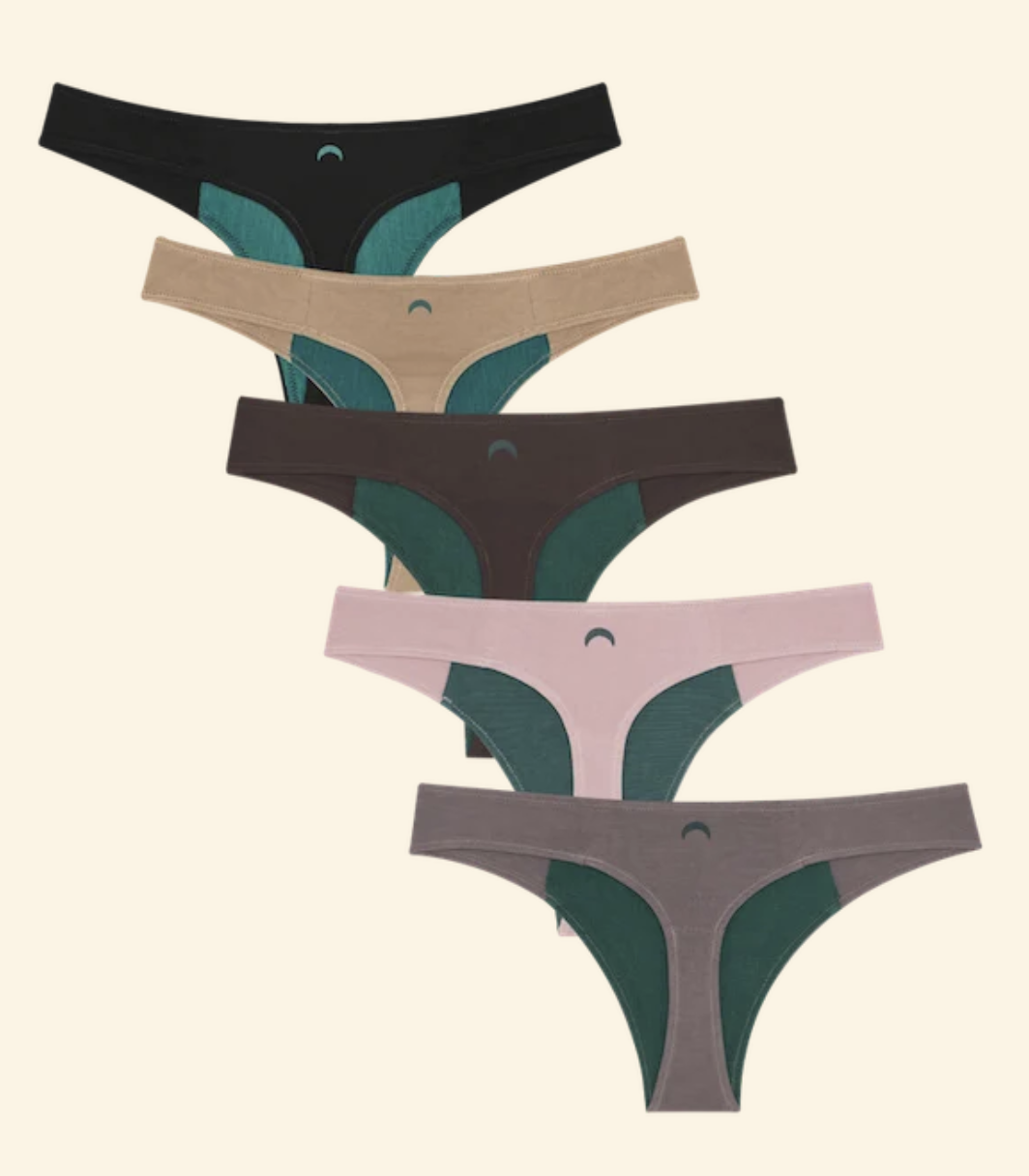
Huha thong featuring their signature green, zinc-infused lining
source: https://hu-ha.com/
Quince — Best Affordable Organic Cotton Underwear
Honestly, I don't think you need to spend $20–30 on every single pair of underwear.
And that's exactly why Quince made the list.
Its organic cotton bikini, hipster, and thong multipacks are made with 95% organic cotton and 5% spandex. The cotton is OCS-certified, and Quince also lists OEKO-TEX certification on its organic cotton underwear.
At the time of writing, several six-packs come out to roughly $5 per pair. That's pretty difficult to beat.
What I like
95% Certified organic cotton
OCS certified and OEKO-TEX certified
Most affordable option on the list and a great entry point into organic underwear brands
Bikini, hipster, thong, and high-waisted briefs
Things to consider
Quince is a huge retailer, not an underwear company. You're not getting the specialized design details you'll find with Huha or the distinctive fabric experience of LunaLeila.
The designs are fairly basic, and the size range isn't as extensive as some brands in this guide. But if you are looking for a good basic at an affordable price, they’re great!
My verdict
If budget is your biggest consideration, Quince is the best choice.
It's especially appealing if your underwear drawer is full of worn-out basics and you want to replace several pairs without spending much extra money.
I’ve purchased several Quince products over the years. You can read my review of their linen bedding here.
Organic Basics — Best Minimalist Organic Underwear
Organic Basics is probably one of the first brands you'll come across when searching for sustainable underwear brands.
Organic Basics focuses heavily on simple wardrobe staples and offers underwear in several predominantly organic cotton fabrics.
The Organic Basics aesthetic is minimal, neutral, and modern, which makes it especially appealing if you want healthier materials without your underwear looking overly “granola.” You know the aesthetic....
What I like
Organic fabrics
Simple, modern design and a good variety of styles (they also have a full clothing line beyond bras and undies)
Multiple cuts and coverage options (their flex cheeky brief and core ribbed thong are some of my faves)
Broad size range on several styles
Depending on the current Organic Basics underwear collection, you'll find everything from thongs and briefs to more full-coverage options.
Things to consider
Not every Organic Basics product uses the same fabric composition. That's something I always pay attention to with larger sustainable brands.
Rather than assuming everything sold by Organic Basics uses identical sustainable fabrics, check the materials and certifications on the exact style you're considering.
The other thing I’ve noticed is some of the waistbands not holding up with washes quite as well as some of the other brands on the list. Running around $8-15 a pair, they're kind of in the middle of the pack for affordability, so just keep that in mind!
My verdict
Organic Basics offers some of the prettiest, minimalist, everyday options on this list. I also love that they have a more extensive clothing line including loungewear, activewear, and everyday clothing.
Overall, I think they provide some good options for non-toxic underwear and clothing with breathable fabrics.
Subset — Best Classic Organic Cotton Underwear
Subset is another excellent option if certified organic cotton is your priority. Its underwear is made primarily from certified organic cotton, and the company maintains a GOTS-certified supply chain.
And there are a LOT of different cuts and options.
Subset offers everything from low-rise thongs and bikinis to briefs and shorties, with options ranging from barely-there to full coverage. Depending on your preferred cut, you can find something closer to bikini briefs, a high-rise brief, or a more traditional full brief.
What I like
Certified organic cotton and GOTS-certified supply chain
Wide range of cuts and rises, with plenty of full coverage options
Inclusive sizing
First Pair Guarantee
Underwear recycling program for 20% off your next order
Things to consider
Slightly more expensive option. That said, they feel very high-quality and any pairs I have had have held up great through frequent wearing and washing.
My verdict
Subset is my favorite choice for classic organic cotton underwear with plenty of fit options.
It's particularly good if you prefer organic cotton briefs over silky lyocell fabrics or simply want more coverage.
Honorable Mention: Pact Underwear
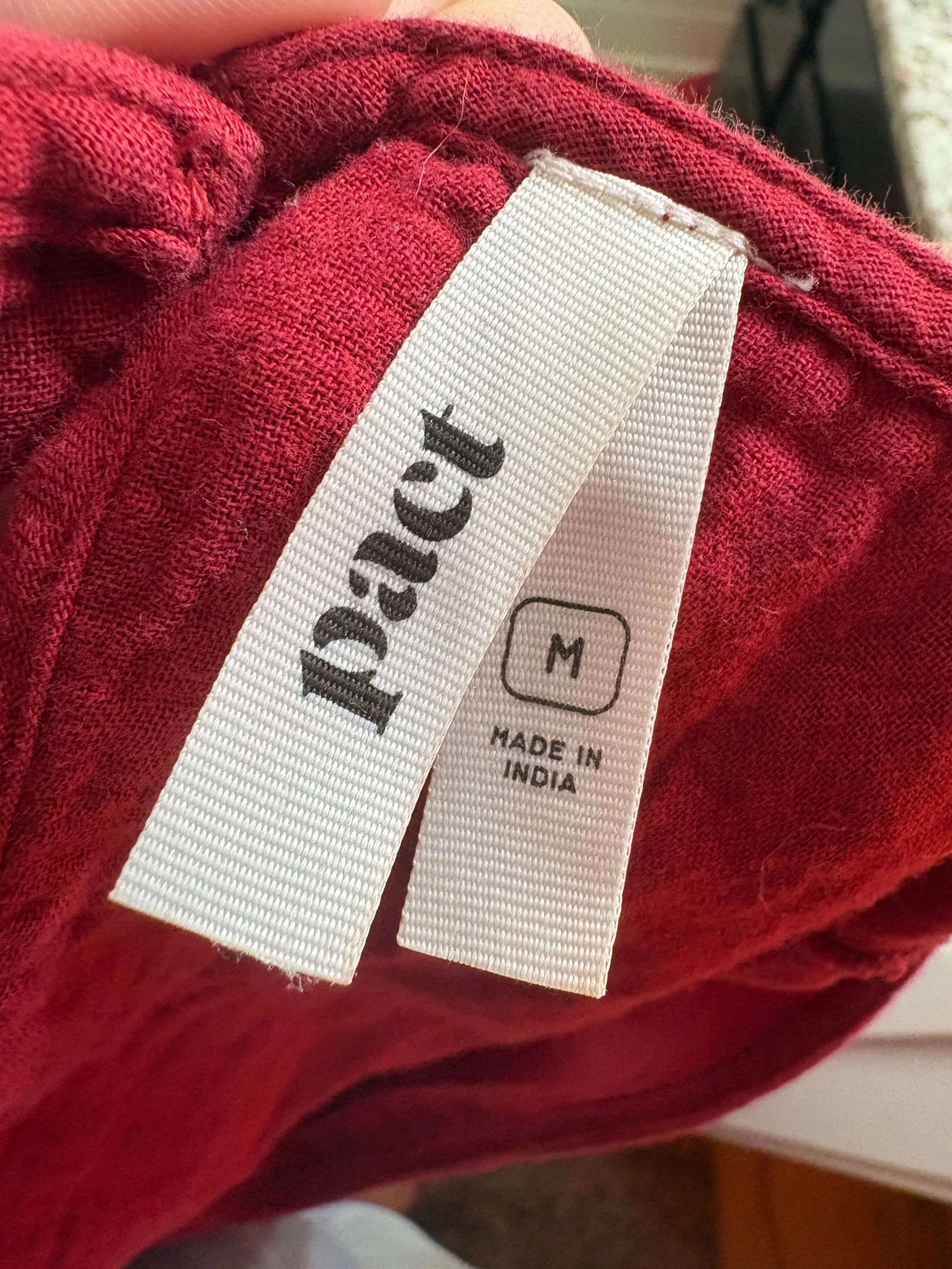
If you're searching for the best organic cotton underwear brands, Pact is one of the most popular recommendations. Pact's Everyday underwear is made primarily with GOTS-certified organic cotton, with a small percentage of elastane for stretch.
The Global Organic Textile Standard is one of the certifications I specifically like seeing when shopping for organic undergarments because it addresses more than simply the raw cotton.
Pact has also built much of its brand around sustainable fashion, organic materials, and greater transparency throughout its supply chain.
That said, I do not love the fit of their underwear personally. I feel like the elastic on the legs is a bit tighter than other brands. So, if you’re like me and carry your weight in your hips and thighs, I would recommend sizing up for a comfier fit.
While their underwear is not my personal fave for fit, I do love a lot of Pact’s other clothing options and safety commitments as a brand.
What I like
Soft and breathable GOTS-certified organic cotton
Multiple rises and cuts
Multipacks available
More accessible price range than some specialty brands
Good option for someone wanting simple organic panties
Things to consider
The elastic on the legs feels tighter than some of the other brands. Personally, I would have preferred sizing up for a more comfortable fit.
Limited selection and prints. Overall, the prints and styles aren't my fave compared to others on the list.
My verdict
Personally, it is not my favorite fit of those on the list, but I know many people love their underwear. It's just a personal opinion! That said, I would probably recommend sizing up for optimal comfort, especially if you carry your weight more in your hips and thighs.
Which Non-Toxic Underwear Is Best?
There isn't one pair that's going to be the best choice for every person or body type. Everyone has their own personal preferences when it comes to clothing, especially underwear.
Here's how I'd narrow it down:
Choose LunaLeila if: You hate feeling your underwear and want something incredibly lightweight, soft, and breathable. Plus, you get the confidence of some of the strictest safety regulations with their OEKO-TEX Class 1 certification.
Choose Huha if: You prioritize breathability, moisture management, and a thoughtfully designed gusset.
Choose Quince if: You want affordable organic cotton undies and need to replace several pairs at once.
Choose Organic Basics if: You want simple, modern organic underwear with a minimalist aesthetic.
Choose Subset if: You prefer classic cotton underwear, fuller coverage, or want a larger variety of styles.
For most people, I actually think the ideal underwear drawer may include a combination.
Different underwear works for different days. You might prefer lightweight lyocell under leggings, cotton briefs for lounging around the house, and an inexpensive Quince multipack for your everyday basics.
Is Organic Cotton Better for Underwear?
If you're specifically looking for natural fibers, organic cotton is a great option for underwear. Compared with conventional cotton, certified organic cotton is grown according to standards that restrict certain synthetic pesticides and fertilizers.
You'll sometimes see claims that organic cotton always uses less water or less energy than conventional cotton. The actual environmental impact can vary considerably depending on where and how the cotton is grown, irrigation, yield, manufacturing, transportation, and many other factors.
That's why I wouldn't choose a brand based on one sustainability statistic alone.
Instead, I look at the bigger picture: certifications, materials, durability, transparency, and whether a company appears to be making meaningful sustainable practices part of its business.
After all, the most sustainable pair of underwear is probably one you'll actually wear repeatedly rather than constantly replacing.
Is Cotton or Bamboo Better for Underwear?
Neither is automatically better. It comes down mostly to what you want your underwear to feel like.
Certified organic cotton is breathable, familiar, durable, and widely available. It's also easier to find with certifications such as GOTS.
If you love that substantial, traditional underwear feeling, go cotton. If your dream underwear basically feels like nothing, I'd look at lyocell (like LunaLeila).
And remember: “bamboo” alone doesn't tell you much about the finished fabric.
Bamboo has to undergo processing to become textile fiber, which is why I pay more attention to the finished material, production process, and third-party certifications than the word bamboo on the label.
What Underwear Materials Should You Avoid?
I hesitate to give you a dramatic list of fabrics you should “never” wear because that's just not how I approach wellness. Polyester and nylon are widely used throughout the fashion industry, and occasionally wearing synthetic underwear isn't something I personally worry about.
That said, I don't seek out underwear made primarily from synthetic fabrics when there are comfortable alternatives I prefer.
I generally look for underwear made primarily from:
Certified organic cotton
TENCEL™ lyocell
TENCEL™ modal
Bamboo-derived lyocell
Other thoughtfully sourced natural fabrics
And again, a little elastane or spandex doesn't bother me. I want my underwear to stay in place throughout the day and keep their shape!
Don't Throw Away Your Entire Underwear Drawer
Seriously.
If you're reading this while mentally calculating how much it would cost to replace every pair you own with certified organic cotton panties, you can stop.
Wear what you have. When your old undies stretch out, develop holes, or simply need replacing, choose something you genuinely like.
For many styles, washing in cold water and following the manufacturer's care instructions can also help reduce unnecessary wear.
I approach most “non-toxic swaps” this way. Slowly replacing things when you actually need them is a lot more realistic, and usually a lot less expensive, than trying to create a perfectly clean home or wardrobe overnight.
Related Reads:
FAQs About Non-Toxic and Organic Underwear
What is the healthiest underwear material?
There isn't one universally “healthiest” underwear material.
Breathable fabrics like cotton and lyocell are both good options for everyday underwear. I personally prioritize certified organic cotton and certified lyocell fabrics because they offer a combination of comfort, breathability, and greater manufacturing transparency.
Is organic cotton underwear worth it?
I think it can be, particularly for something you wear directly against your skin every day.
GOTS certified organic cotton also provides more information about how the cotton and finished textile are produced than simply seeing the word “cotton” on a label.
That doesn't mean you need to throw away perfectly functional underwear made from conventional cotton. I prefer making these changes gradually as existing items wear out.
What are the best organic cotton underwear brands?
For the best organic cotton underwear brands, I'd start with Quince, Subset, or Organic Basics.
Quince is the best affordable option, Subset offers a particularly good variety of fits, and Organic Basics is ideal for someone who prefers minimalist designs. Pact can also be a good choice-but personally, the fit wasn't my fave.
Are organic cotton underwear better for sensitive skin?
Some people with sensitive skin prefer simple, breathable fabrics and may find organic cotton panties comfortable.
However, organic certification doesn't guarantee that a particular garment won't irritate your skin. Dyes, elastic, detergents, seams, and individual sensitivities can all matter.
If you have particularly reactive skin, look at the entire garment rather than assuming “organic” automatically means hypoallergenic or sensitive skin-friendly.
What does OEKO-TEX certified underwear mean?
OEKO-TEX Standard 100 certification means a finished textile has been tested according to limits for a range of potentially harmful chemicals. Speaking. ofcertifications.. OEKO-TEX and GOTS aren't interchangeable.
OEKO-TEX focuses heavily on testing textiles for certain substances, while the Global Organic Textile Standard (GOTS) includes requirements surrounding certified organic fibers and textile processing.
I consider both useful certifications, just for somewhat different reasons. If you’re curious about safety certification and what a little more info, here is a great educational post.
Is bamboo underwear non-toxic?
Not necessarily. “Bamboo” describes the plant the cellulose originally came from. It doesn't tell you everything about the finished textile.
If you're considering bamboo underwear, I prefer bamboo-derived lyocell from a company that provides additional third-party testing or certification rather than choosing something simply because “bamboo” appears on the package.
That's one reason LunaLeila stood out to me: its bamboo-derived lyocell fabric is OEKO-TEX Standard 100 Class I certified. Basically, the cleanest you can get.
Is polyester underwear bad for you?
I wouldn't go so far as to say wearing polyester underwear is inherently harmful.
My preference is simply to choose more breathable, predominantly natural or cellulose-based fabrics for something that sits directly against sensitive areas all day.
Does non-toxic underwear need to be 100% cotton?
No. In fact, almost every pair in this guide incorporates a small percentage of elastane or spandex to provide stretch.
I care much more about the primary fabric, certifications, breathability, and overall construction than achieving an arbitrary 100% natural-fiber requirement.
Is Pima cotton good for underwear?
Pima cotton is known for its long fibers and soft feel, so organic Pima cotton can make beautifully soft underwear.
However, the term Pima cotton doesn't automatically mean the cotton is organic, GOTS certified, Fair Trade, or produced without particular chemicals.
As always, look beyond the fiber name at the certifications and manufacturing information provided by the brand.
Is Fair Trade underwear better?
Fair Trade certification and similar programs primarily address social and economic aspects of manufacturing rather than whether a fabric is inherently healthier to wear.
For shoppers concerned about ethical manufacturing, information about fair wages, worker protections, Fair Trade Certified factories, and transparent supply chains can absolutely be valuable.
What styles of organic underwear can you buy?
Pretty much all of them.
Depending on the brand, you'll find organic cotton panties, thongs, low-rise bikinis, classic fit bikinis, bikini briefs, hipsters, high-waisted briefs, a high-rise brief, boy shorts, and full briefs.
The best choice comes down to your personal preference and body type.
Final Thoughts
Underwear isn't the most glamorous wellness swap, but similar to swapping out your deodorant, it's one of those things you use every single day. And thankfully, choosing organic fabrics, natural fibers, and brands with greater manufacturing transparency no longer means wearing thick, beige granny panties.
LunaLeila is the standout if you want an incredibly light, soft, “am I even wearing underwear?” feel, especially if you prefer silky lyocell over traditional cotton. Huha is an overall favorite for its combination of breathable TENCEL™ fibers and thoughtful mineral-lined design.
For organic cotton undies, I'd look at Organic Basics or Subset, while Quince is hard to beat for affordability.
Most importantly, you don't need to overhaul your underwear drawer overnight. Wear what you already own, replace things as they wear out, and use guides like this to make your next purchase a little more intentional.
What are your favorite underwear for comfort and breathability? I always love learning about new brands!
Kaelyn
latest on the blog…
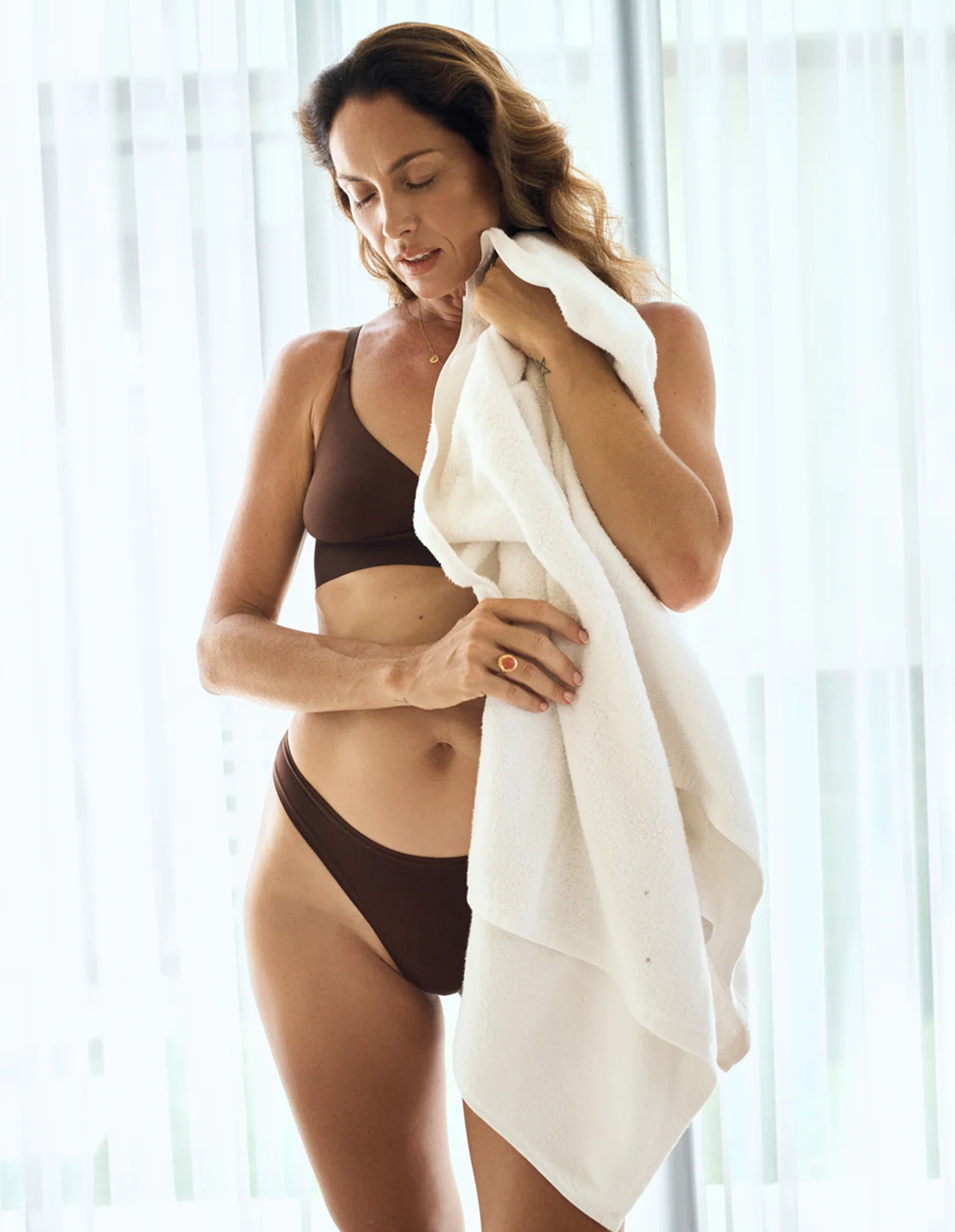







After trying dozens of underwear brands, here are the tried-and-true options for comfort, healthy fabrics, and affordability.